How the Jews Defeated Hitler by Benjamin Ginsberg
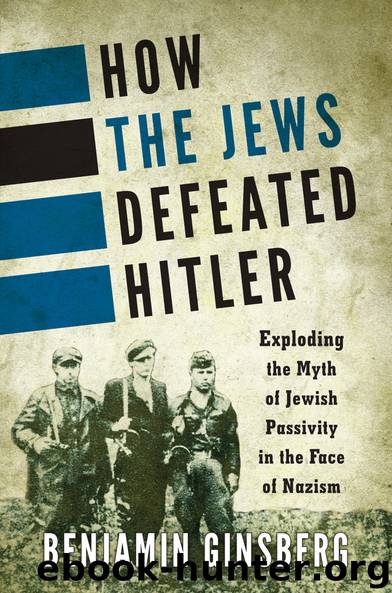
Author:Benjamin Ginsberg [Ginsberg, Benjamin]
Language: eng
Format: epub
Publisher: Rowman & Littlefield Publishers
Published: 2013-08-12T16:00:00+00:00
5
Partisan Warfare
Resistance movements developed in virtually every nation and territory under German occupation during the war. Many of these movements received support from external sponsors, particularly the Soviet Union, Great Britain, and the United States, which sent arms, supplies, and military advisors to partisans they deemed useful. Western European partisans, for example, received much of their equipment, training, and leadership from Britain’s Special Operations Executive (SOE).1 Resistance groups varied in size and militancy. The Dutch believed in peaceful resistance, a tactic that did not have much success against the Germans. Soviet partisans, on the other hand, relied on bombs and automatic weapons, which, given the nature of their foe, seemed to hold out more promise of success.
Compared to armored divisions and swarms of attack planes, lightly armed partisans would not seem to pose much of a military threat. Even today, when insurgents frequently practice asymmetric warfare against the United States, America knows that its adversaries would prefer to use missiles and tanks if they could afford them. During World War II, though, several factors made the Germans potentially vulnerable to partisan warfare and made the partisan, at least potentially, a useful weapon against the Wehrmacht.
First, German supply lines, especially in the east, were long and fragile. Troops, ammunition, fuel, and so forth had to be moved over long distances on rail lines that could be, and often were, interdicted and disrupted by partisans. Germany depended upon these same rail lines for shipments of such strategic materials as bauxite, nickel, and chrome, also subject to interdiction. Second, when it came to food, the Wehrmacht, especially in the east, had planned to live off the land—that is, German planners counted on being able to feed their troops from local sources in the conquered lands. Partisans, pursuing a scorched-earth policy, could cause serious food problems for the German army. Third, Germany had conquered virtually all of Europe and faced some partisan activity in every conquered country. With the exception of the Soviet partisans, no individual set of guerilla fighters posed a major challenge to the Germans. Cumulatively, however, partisans sapped German strength.
Germany relied, especially in Western Europe, on the help of local police forces to deal with partisans, and especially in France and Holland, these local police were quite helpful.2 Nevertheless, hundreds of thousands of German military police officers were deployed to maintain security in Europe, especially in the Soviet Union.3 According to one estimate, as many as 500,000 German soldiers and security personnel were assigned to combat partisans behind German lines in the USSR alone.4 These deployments were in addition to whatever German military garrisons might also be assigned to each nation, in part for internal and in part for external security. All together, this placed a substantial burden on Germany’s limited manpower resources. Thus, as historian Jorgen Haestrup observes, when the Germans needed every man to fight the Soviets in 1943, 380,000 troops were assigned to Norway, 360,000 to Yugoslavia, 65,000 to Holland, and so forth.5
The Jews had the most to lose from the German occupation.
Download
This site does not store any files on its server. We only index and link to content provided by other sites. Please contact the content providers to delete copyright contents if any and email us, we'll remove relevant links or contents immediately.
| Africa | Americas |
| Arctic & Antarctica | Asia |
| Australia & Oceania | Europe |
| Middle East | Russia |
| United States | World |
| Ancient Civilizations | Military |
| Historical Study & Educational Resources |
Cecilia; Or, Memoirs of an Heiress — Volume 1 by Fanny Burney(32558)
Cecilia; Or, Memoirs of an Heiress — Volume 2 by Fanny Burney(31956)
Cecilia; Or, Memoirs of an Heiress — Volume 3 by Fanny Burney(31941)
The Secret History by Donna Tartt(19088)
Sapiens: A Brief History of Humankind by Yuval Noah Harari(14389)
Leonardo da Vinci by Walter Isaacson(13336)
The Radium Girls by Kate Moore(12028)
Sapiens by Yuval Noah Harari(5370)
How Democracies Die by Steven Levitsky & Daniel Ziblatt(5218)
The Wind in My Hair by Masih Alinejad(5095)
Homo Deus: A Brief History of Tomorrow by Yuval Noah Harari(4918)
Endurance: Shackleton's Incredible Voyage by Alfred Lansing(4781)
Man's Search for Meaning by Viktor Frankl(4605)
The Silk Roads by Peter Frankopan(4534)
Millionaire: The Philanderer, Gambler, and Duelist Who Invented Modern Finance by Janet Gleeson(4478)
The Rape of Nanking by Iris Chang(4211)
Joan of Arc by Mary Gordon(4109)
The Motorcycle Diaries by Ernesto Che Guevara(4098)
Stalin by Stephen Kotkin(3965)
